Greasy Shuffle
Swaggering blues shuffle in E — open position, wide-open jam.
Jam this track with live chords →Do-re-mi, on six strings. The major scale — 1, 2, 3, 4, 5, 6, 7, built from the step pattern whole-whole-half-whole-whole-whole-half — is the reference point for every other scale and chord name in Western music. In C: C, D, E, F, G, A, B.
Chord names, key signatures, the modes, "b3" and "#4" — all of it is measured against the major scale. Learn it in one key on one octave and the entire vocabulary of music theory becomes readable. And hiding inside it: the major pentatonic is just degrees 1-2-3-5-6, and each of the seven modes is this same scale started from a different note.
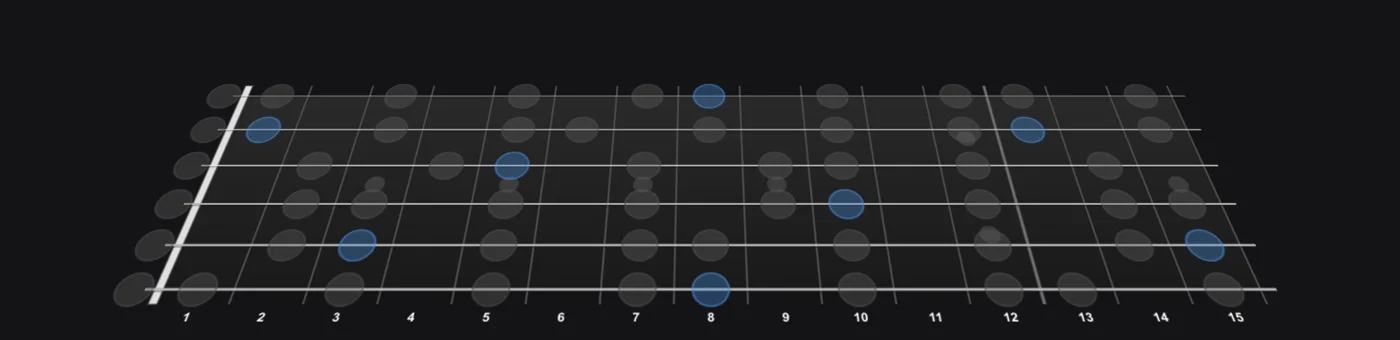
Walk the major scale with a metronome — interactive fretboard →
Harmonise the C major scale in thirds and you get the seven diatonic chords — the chord palette of every song in C:
| Degree | I | ii | iii | IV | V | vi | vii° |
|---|---|---|---|---|---|---|---|
| Chord | C | Dm | Em | F | G | Am | Bdim |
That I–ii–iii–IV–V–vi–vii° pattern holds in every key — see the per-key pages for each key's chords spelled out.
| Key | 1 | 2 | 3 | 4 | 5 | 6 | 7 |
|---|---|---|---|---|---|---|---|
| A | A | B | C# | D | E | F# | G# |
| Bb | Bb | C | D | Eb | F | G | A |
| B | B | C# | D# | E | F# | G# | A# |
| C | C | D | E | F | G | A | B |
| C# | C# | D# | E# | F# | G# | A# | B# |
| D | D | E | F# | G | A | B | C# |
| Eb | Eb | F | G | Ab | Bb | C | D |
| E | E | F# | G# | A | B | C# | D# |
| F | F | G | A | Bb | C | D | E |
| F# | F# | G# | A# | B | C# | D# | E# |
| G | G | A | B | C | D | E | F# |
| Ab | Ab | Bb | C | Db | Eb | F | G |
Most players organise the major scale with the CAGED system — five overlapping shapes anchored to the C, A, G, E and D chord forms — or with three-notes-per-string patterns for speed. Either way the payoff is the same: one movable system, twelve keys for free.
Hear the major scale as music, not an exercise — these free major-key tracks are made for it:
Swaggering blues shuffle in E — open position, wide-open jam.
Jam this track with live chords →
Driving rock on an A–D–G vamp — crunchy major chords, arena energy.
Jam this track with live chords →